


>
!8!# Wholesale Best Bait For Mouse Trap Bargain Sale Bio Force Gym !8!# Catalog Lexmark X9350
Source: http://singingkaraokemachinebuynow.blogspot.com/2011/09/cam-ranh-bay-vietnam-first-duty-station.html
http://www.nciec.gov.vn/owned.
http://sgtvtgialai.gov.vn notified by LatinHackTeam http://www.zone-h.org/mirror/
http://bacho.camau.gov.vn notified by LatinHackTeam http://www.zone-h.org/mirror/
http://ndwrpi.gov.vn notified by LatinHackTeam http://www.zone-h.org/mirror/
http://tthc.bacgiang.gov.vn/
http://tcdlcl.dosttn.gov.vn/
http://kntc.bacgiang.gov.vn/
http://ndwrpi.gov.vn notified by LatinHackTeam http://www.zone-h.org/mirror/
http://tthc.bacgiang.gov.vn/
http://tcdlcl.dosttn.gov.vn/
http://kntc.bacgiang.gov.vn/
Sau đợt tấn công hàng trăm website của Việt Nam vào tuần trước, Hacker Trung Quốc lại tiếp sử dụng phương thức DDOS để tấn công vào các website hàng đầu của Việt Nam. Nguyên nhân của sự việc này là thông tin các "hacker" Việt Nam tấn công các website của TQ được đăng tải trên các trang mạng của TQ, sự việc này đã làm nổi lên làn sóng phản công của các hacker TQ.
Điển hình là diễn đàn hacker lớn nhất Việt Nam HVAonline.net và trang tin tức tintuc.xalo.vn đã bị tấn công khá nặng nề dẫn đến tình trạng bị tê liệt một số thời gian.


Sau đợt tấn công hàng trăm website của Việt Nam vào tuần trước, Hacker Trung Quốc lại tiếp sử dụng phương thức DDOS để tấn công vào các website hàng đầu của Việt Nam. Nguyên nhân của sự việc này là thông tin các "hacker" Việt Nam tấn công các website của TQ được đăng tải trên các trang mạng của TQ, sự việc này đã làm nổi lên làn sóng phản công của các hacker TQ.
Điển hình là diễn đàn hacker lớn nhất Việt Nam HVAonline.net và trang tin tức tintuc.xalo.vn đã bị tấn công khá nặng nề dẫn đến tình trạng bị tê liệt một số thời gian.
Tờ báo điện tử đưa tin đầu nguồn về các vụ tàu Trung Quốc xâm phạm lãnh hải, cắt cáp thăm dò địa chấn của các tàu Petrovietnam vừa bị tấn công làm tê liệt tối qua, 9/6.
Dữ liệu website Petrotimes.vn cũng bị hacker xóa sạch nhưng rất may đã được sao lưu đầy đủ nên không gây thiệt hại nào đáng kể.

Tờ báo điện tử đưa tin đầu nguồn về các vụ tàu Trung Quốc xâm phạm lãnh hải, cắt cáp thăm dò địa chấn của các tàu Petrovietnam vừa bị tấn công làm tê liệt tối qua, 9/6.
Dữ liệu website Petrotimes.vn cũng bị hacker xóa sạch nhưng rất may đã được sao lưu đầy đủ nên không gây thiệt hại nào đáng kể.
Liên tiếp trong vài ngày gần đây, nhiều người phát hiện ra hàng loạt website của các tổ chức lớn tại Việt Nam đồng loạt bị tấn công nhằm mục đích deface (thay đổi) giao diện trang chủ. Dựa trên thông điệp để lại: "HACKED BY HASHOR "ASHIYANE DIGITAL SECURITY TEAM"" - 1 thành viên nhóm hacker Ashiyane của Iran đang là đối tượng bị tình nghi.
Trong số các nạn nhận của đợt tấn công này, có thể thấy nhiều cái tên thuộc các tổ chức, cơ quan lớn như tên miền: BigC.vn (đăng ký bởi công ty thương mại quốc tế và dịch vụ Đại Siêu Thị Big C), donglucsport.com.vn (công ty thể thao Động Lực), tanhoangviet.com.vn (công ty thương mại kỹ thuật Tân Hoàng Việt), ceci.org.vn (trung tâm nghiên cứu hợp tác quốc tế Canada), cect.gov.vn (trung tâm tư vấn công nghệ và môi trường - Tổng cục môi trường), sonongnghiep.binhduong.gov.vn (Sở nông nghiệp Bình Dương)...
Ngay cả tên miền rất có giá trên thị trường chuyển nhượng là: baobongda.com.vn cũng bị tấn công. Rất may, lỗ hổng bảo mật trên các website trên đã hầu hết đã được khắc phục và hoạt động trở lại bình thường.
Theo tìm hiểu, Ashiyane Digital Security Team (ADST) là một trong ba nhóm hacker nổi tiếng nhất Iran, bên cạnh Iran Hackers Sabotage Team và Iran Babol-Hackers Security Team. Theo số liệu của Zone-H, ADST chịu trách nhiệm cho hàng ngàn vụ tấn công khác nhau, tính cả các vụ do từng thành viên đơn lẻ thực hiện.
Cũng giống như nhóm Iran Hackers Sabotage Team, mục đích chính của ADST là thông qua việc hack các trang web, chúng muốn bán những thông tin trợ giúp an ninh mạng, web hosting và dịch vụ mạng. Bên cạnh đó cũng có nhiều bằng chứng cho thấy động cơ chính trị trong những hành động phá hoại. Đơn cử như vụ tấn công vào trang web của NASA do nhóm này tiến hành là một câu trả lời cho những động thái của Mỹ tại Trung Đông.
ADST được tổ chức khá bài bản và quy củ. Chúng được chia thành nhiều nhóm, phụ trách nhiều mảng khác nhau như quản lý, thiết kế phần mềm hay nhóm chỉ có nhiệm vụ thay đổi hoàn toàn giao diện trang web bị hack.
Độ tuổi các thành viên ADST trung bình từ 16 đến 28 tuổi, nhóm người này sở hữu những kỹ năng công nghệ thông tin đa dạng. Phần lớn các thành viên đều thông thạo việc sử dụng các hệ điều hành như Windows, UNIX, Cisco IOS hay LINUX. Một số khác lại có kinh nghiệm lập trình trên nhiều nền ngôn ngữ như C, C++, VC++, Delphi hay Perl.
Mặc dù kỹ năng có thể khác nhau, nhưng tất cả đều “khoe khoang” đã có kinh nghiệm hack các hệ thống mạng, vượt tường lửa, bẻ khóa các shareware... Một vài thành viên thậm chí còn mở những lớp học dạy can thiệp vào hệ thống mạng, phân chia theo các cấp độ khác nhau.
Cuộc tấn công của ADST nhằm vào nhiều website Việt Nam có lẽ chỉ mang ý nghĩa lấy thành tích và tập luyện. Tuy nhiên, dù với lý do gì thì các hành động này cũng đáng bị lên án.
(Tổng hợp - gameK)

--------------------------------------------------------------------------------------------------------------------------------------------------------
Việc nhóm hacker Iran hay Thổ Nhĩ Kỳ tấn công vào các web site tại Việt Nam đã ko còn là lạ, với việc lơ là bảo mật và chưa đầu tư nhiều vào công tác bảo mật nên các Website Việt Nam thường mắc những lỗi bảo mật rất căn bản. Qua tìm hiểu của mình thì các nhóm hacker Trung Đông tấn công các website của Vn thường bằng những lỗi sau đây:
Liên tiếp trong vài ngày gần đây, nhiều người phát hiện ra hàng loạt website của các tổ chức lớn tại Việt Nam đồng loạt bị tấn công nhằm mục đích deface (thay đổi) giao diện trang chủ. Dựa trên thông điệp để lại: "HACKED BY HASHOR "ASHIYANE DIGITAL SECURITY TEAM"" - 1 thành viên nhóm hacker Ashiyane của Iran đang là đối tượng bị tình nghi.
Trong số các nạn nhận của đợt tấn công này, có thể thấy nhiều cái tên thuộc các tổ chức, cơ quan lớn như tên miền: BigC.vn (đăng ký bởi công ty thương mại quốc tế và dịch vụ Đại Siêu Thị Big C), donglucsport.com.vn (công ty thể thao Động Lực), tanhoangviet.com.vn (công ty thương mại kỹ thuật Tân Hoàng Việt), ceci.org.vn (trung tâm nghiên cứu hợp tác quốc tế Canada), cect.gov.vn (trung tâm tư vấn công nghệ và môi trường - Tổng cục môi trường), sonongnghiep.binhduong.gov.vn (Sở nông nghiệp Bình Dương)...
Ngay cả tên miền rất có giá trên thị trường chuyển nhượng là: baobongda.com.vn cũng bị tấn công. Rất may, lỗ hổng bảo mật trên các website trên đã hầu hết đã được khắc phục và hoạt động trở lại bình thường.
Theo tìm hiểu, Ashiyane Digital Security Team (ADST) là một trong ba nhóm hacker nổi tiếng nhất Iran, bên cạnh Iran Hackers Sabotage Team và Iran Babol-Hackers Security Team. Theo số liệu của Zone-H, ADST chịu trách nhiệm cho hàng ngàn vụ tấn công khác nhau, tính cả các vụ do từng thành viên đơn lẻ thực hiện.
Cũng giống như nhóm Iran Hackers Sabotage Team, mục đích chính của ADST là thông qua việc hack các trang web, chúng muốn bán những thông tin trợ giúp an ninh mạng, web hosting và dịch vụ mạng. Bên cạnh đó cũng có nhiều bằng chứng cho thấy động cơ chính trị trong những hành động phá hoại. Đơn cử như vụ tấn công vào trang web của NASA do nhóm này tiến hành là một câu trả lời cho những động thái của Mỹ tại Trung Đông.
ADST được tổ chức khá bài bản và quy củ. Chúng được chia thành nhiều nhóm, phụ trách nhiều mảng khác nhau như quản lý, thiết kế phần mềm hay nhóm chỉ có nhiệm vụ thay đổi hoàn toàn giao diện trang web bị hack.
Độ tuổi các thành viên ADST trung bình từ 16 đến 28 tuổi, nhóm người này sở hữu những kỹ năng công nghệ thông tin đa dạng. Phần lớn các thành viên đều thông thạo việc sử dụng các hệ điều hành như Windows, UNIX, Cisco IOS hay LINUX. Một số khác lại có kinh nghiệm lập trình trên nhiều nền ngôn ngữ như C, C++, VC++, Delphi hay Perl.
Mặc dù kỹ năng có thể khác nhau, nhưng tất cả đều “khoe khoang” đã có kinh nghiệm hack các hệ thống mạng, vượt tường lửa, bẻ khóa các shareware... Một vài thành viên thậm chí còn mở những lớp học dạy can thiệp vào hệ thống mạng, phân chia theo các cấp độ khác nhau.
Cuộc tấn công của ADST nhằm vào nhiều website Việt Nam có lẽ chỉ mang ý nghĩa lấy thành tích và tập luyện. Tuy nhiên, dù với lý do gì thì các hành động này cũng đáng bị lên án.
(Tổng hợp - gameK)
--------------------------------------------------------------------------------------------------------------------------------------------------------
Việc nhóm hacker Iran hay Thổ Nhĩ Kỳ tấn công vào các web site tại Việt Nam đã ko còn là lạ, với việc lơ là bảo mật và chưa đầu tư nhiều vào công tác bảo mật nên các Website Việt Nam thường mắc những lỗi bảo mật rất căn bản. Qua tìm hiểu của mình thì các nhóm hacker Trung Đông tấn công các website của Vn thường bằng những lỗi sau đây:

When the last US combat brigade left Iraq last week, it did so in triumph. The 4th Stryker Brigade, 2nd Infantry Division rolled across the border into Kuwait leaving an Iraq that is relatively stable, even though many politicians and opponents of the war had called it hopeless less than four years ago. Many of the same people are similarly painting the war in Afghanistan as a lost cause today.
We should all be proud of the magnificent job that the US military has done in Iraq and Afghanistan. Units who fought in these theaters of the War on Terror include soldiers from the Georgia Army National Guard, Rangers from Hunter Army Air Field, and elements of the 3rd Infantry Division from Fort Benning. Georgia soldiers also served with units based around the country and the world.
The wars in Iraq and Afghanistan have long been compared to the US experience in Vietnam with many warning of a quagmire as US forces engaged al Qaeda and Shiite insurgents. It is possible however, that many in this country have learned the wrong lesson from the history of the Vietnam War.
It is widely believed in some circles that it is almost impossible for a conventional force to defeat insurgents fighting a guerilla war. This view is ignorant both of world military history as well as the history of the many small wars that the US has fought around the world. The US military, especially the Marine Corps, has defeated or neutralized insurgents in Haiti, the Dominican Republic, the Philippines, Nicaragua, and even Vietnam. The story of these and other conflicts is detailed in Max Boot’s The Savage Wars of Peace.
Boot disputes the conventional wisdom that the US military was defeated by the Viet Cong in a guerilla war. He explains how General William Westmoreland was the wrong man for the command of the US forces in Vietnam. Westmoreland was a West Pointer who tried to fight a conventional, big unit war similar to what he experienced in WWII and Korea.
Mounting casualties led to increasing public opposition, especially after the Tet Offensive of 1968. During Tet, the VC violated an armistice to launch surprise attacks around South Vietnam. The scale of the attacks convinced many, including veteran newsman Walter Cronkite, that the insurgency was not nearly defeated, as many in the government and the military had claimed. In reality, Tat was a huge defeat for the VC. WE and ARVN counterattacks decimated VC ranks and they never recovered (Boot, p. 310).
In the wake of Tet, General Westmoreland was replaced by General Creighton Abrams. Abrams implemented a “one war” strategy that focused on “clear and hold” in a manner similar to General Piraeus’ successful strategy in Iraq. William Colby, leader of the CIA’s Phoenix Program was also instrumental in turning the war around. The Phoenix Program targeted VC cadres in South Vietnam and was responsible. The program led to the killing of 26,000 local VC as well capturing 33,000 and inducing 22,000 to defect (Boot, p. 310).
The methods of Abrams and Colby were so successful that in 1970, only two years after Tet, 90% of South Vietnam was under Saigon’s control (Boot, p. 311). Sir Richard Thompson, a counterinsurgency expert, wrote in 1970 that he was “able to visit areas and walk through villages which had been under VC control for years. There was a much greater feeling of security and people were ready to take up arms for the government because they sensed that the VC were weaker…. Existing roads are kept open, and more are being repaired and opened monthly” (Boot, p. 311).
Yet we know that the Vietnamese communists ultimately prevailed, overrunning the South and reuniting the nation under communist rule. So what happened? In a word: Congress.
Richard Nixon began a policy of Vietnamization, turning over prosecution of the war to the Vietnamese and drawing down US forces in the country. As US forces left, the North Vietnamese saw an opportunity. On March 30, 1972, the NVA launched its Easter Offensive, a conventional forces invasion of the South. Nevertheless, the ARVN forces were able to hold long enough for US airpower to inflict heavy losses on the invaders and the NVA was ultimately turned back (Boot, p. 310-311).
The strong showing led the North Vietnamese to sign the Paris Peace Treaty on January 27, 1973. This was a victory for the United States since it imposed an immediate ceasefire in addition to stipulating the withdrawal of US troops. President Nixon promised the South Vietnamese that the US would come to their aid if the North Vietnamese broke the ceasefire (http://hnn.us/articles/31400.html).
Unfortunately for the South Vietnamese, President Nixon was forced to resign in 1974. Even before that, Congress passed the Case-Church Amendment on June 19, 1973 which banned US military activity in Southeast Asia after August 15. Congress also cut aid to South Vietnam from $1.26 billion to $700 million (http://hnn.us/articles/31400.html). The North Vietnamese sensed blood in the water.
In 1975, the North Vietnamese launched a second conventional invasion of the South. This time, without American airpower or aid, the ARVNs fell back. Boot reports that the situation was so dire that the South Vietnamese troops had to reuse bandages taken from corpses (p. 310-311). With no American help forthcoming, an angry South Vietnamese President Thieu pleaded, “If [the U.S.] grant full aid we will hold the whole country, but if they only give half of it, we will only hold half of the country” (http://hnn.us/articles/31400.html). Instead, Congress granted no aid and South Vietnam fell in 55 days.
Many of the prominent Democrats who prevented the US from honoring its commitments to South Vietnam also opposed the Iraq War. These include Senators John Kerry and Ted Kennedy.
Knowing the full story of the fall of Saigon, the lesson that we should learn is that when our enemies cannot defeat us on the battlefield, they sow dissension at home. They realize that their best chance is to exhaust the political will of the government’s civilian leaders. General Vo Nguyen Giap, leader of the NVA, stated “We were not strong enough to drive out a half-million American troops, but that was not our aim. Our intention was to break the will of the American Government to continue the war” (Boot, p. 316).
A very real danger is that history will repeat itself in Iraq and Afghanistan. Thanks in large part to the sacrifice and hard work of the US military, Iraq is now much more stable than many observers believed possible a mere four years ago. The turnaround is also due to President Bush’s troop surge and General Petraeus’ counterinsurgency strategy. Afghanistan has further to go, but variations on the same strategy could also work there given enough time. It is a testimony to the stabilizing effect of US forces, and the reality of the danger that remains, that more than half of Iraqis did not want US troops to leave yet (http://frankwarner.typepad.com/free_frank_warner/2010/08/poll-60-of-iraqis-want-us-troops-to-stay.html).
Much of the violence in Iraq was caused by Shiite militia groups supported by Iran. Iran pledged to the Iraqi government in 2007 that it would stop equipping and training these groups (http://www.washingtonpost.com/wp-dyn/content/article/2007/11/06/AR2007110600853.html). This pledge may have been partly to reduce the violence in Iraq and lull the US into a false sense of security, making it politically easier for the Obama Administration to withdraw US combat troops. It might also have been inspired by the possibility of uniting Iraqi Shiites into a political bloc that would elect a government friendly to Iran.
As Iran moves ever closer to developing nuclear weapons, it is possible that they will become emboldened by President Obama’s stated goal of a withdrawal of US forces from Afghanistan by July 2011. A nuclear armed Iran that is faced with only token US opposition might well decide that a conventional invasion of Iraq is in their best interests. After all, Iraq is a long-time enemy that fought a decade long war with Iran in the 1980s. Perhaps more importantly, Iraq also controls significant oil reserves. Control of Iraq’s oil would make Iran exponentially more powerful on the world stage. Nuclear weapons in the Persian Gulf and conventional forces in Iraq would also threaten the vast oil reserves of Saudi Arabia.
The danger for the United States is that, like the Americans of 1975, we will be tempted to wash our hands of Iraq if an Iranian invasion comes. To do so, would be a mistake of the worst order. Not only would Iranian domination of the Persian Gulf threaten our own economy, it would also threaten our allies Israel, Saudi Arabia, Turkey, as well as the economies of the industrialized world. It would be very difficult to form a “coalition of the willing” to stave off a nuclear-armed terrorist state.
Additionally, it would further damage America’s reputation abroad if countries in which the US has invested vast amounts of men and material are allowed to fall to Iran. A fall of Baghdad and Kabul would arouse similar emotions as the famous photo of US embassy personnel being evacuated by helicopter from the roof of the Saigon embassy. It would lead our allies to question whether we can be counted upon and our enemies to sense our weakness.
Americans should make no mistake: Just because US forces are no longer in a combat role in Iraq, it does not mean that the war is over. It merely means that US troops are less likely to die in combat and that native forces are doing the lion’s share of the work. The wars in Iraq and Afghanistan are likely to continue for some time as long as al Qaeda and Iran continue to oppose the elected governments and the US doesn’t cut off aid. As George Orwell once said, “the quickest way to end a war is to lose it.”
Sources:
Boot, Max. The Savage Wars of Peace. Basic Books, New York, NY. 2002
http://www.washingtonpost.com/wp-dyn/content/article/2007/11/06/AR2007110600853.html
http://hnn.us/articles/31400.html
http://www.npr.org/templates/story/story.php?storyId=96350333
http://frankwarner.typepad.com/free_frank_warner/2010/08/poll-60-of-iraqis-want-us-troops-to-stay.html
Denver CO
August 27, 2010

Source: http://captainkudzu.blogspot.com/2010/08/iraq-afghanistan-and-ghost-of-vietnam.html
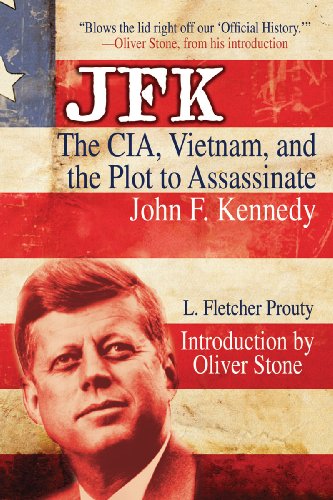
I'm reading a stunning book written by the late L. Fletcher Prouty who served as the chief of special operations for the Joint Chiefs of Staff during the Kennedy presidency. A retired colonel of the U.S. Air Force, Prouty was in charge of the global system designed to provide military support for the CIA's secret activities. He knew where the bodies were buried and the file cabinet containing the paperwork used to cover it up.
Prouty was a source for Oliver Stone's movie "JFK" and was portrayed as "Mr. X" by Donald Sutherland, the man in black who advised New Orleans DA Jim Garrison (portrayed by Kevin Costner) that he was on the trail to the truth.
If you have ANY interest whatsoever in learning the truth of the events that led to what happened to our country on Nov. 22nd, 1963 and changed the course of its direction, read it.
A brief excerpt from the 375+ page book that is the most detailed account of the inception of the CIA and the events that culminated in the coup d'etat on Elm Street in Dallas on a sunny day in November.
Excerpt:
From Chapter 16 - Government by Coup d'Etat
The year was 1964. Pres. John F. Kennedy had been shot dead months before by bursts of "automatic gunfire" in Dallas by "mechanics," that is, skilled gunmen, hired by a power cabal determined to exert control over the United States government. Lyndon B. Johnson, JFK's successor, had been only a few feet under the bullets fired at Kennedy as he rode two cars back in that fatal procession.
By 1964 Johnson was becoming mired in the swamp of the Indochina conflict. Kennedy, who had vowed to "break the CIA into a thousand pieces," was dead. LBJ, who had heard those fatal bullets zing past his ears, had learned the ultimate lesson; and for good measure, Richard Nixon was in Dallas on that fatal day, so that he, too, had the fact of this ever-present danger imprinted on his memory for future use by his masters.
From Chapter 18 - Setting the Stage for the Death of JFK
"The significance of all this was that I had introduced President Kennedy's Vietnam policy statement NSAM #263, into these discussions. It is my belief that the policy announced so forcefully by Kennedy in his earlier NSAM #55 and in NSAM #263 had been the major factor in causing the decision by certain elements of the power elite to do away with Kennedy before his reelection and to take control of the U.S. government in the process.
Kennedy's NSAM #263 policy would have assured that Americans by the hundreds of thousands would not have been sent to the war in Vietnam. This policy was anathema to elements of the military-industrial complex, their bankers, and their allies in the government. This policy and the almost certain fact that Kennedy would have been reelected President in 1964 set the stage for the plot to assassinate him."
I can't put this book down. It is without doubt, the most thorough explanation of the rogue CIA, it's influence and impact on America's involvement in paramilitary operations around the world and subsequent growing conflicts. It is, as Prouty describes:
"...For the world as a whole, the CIA has now become the bogey that communism had been for America. Wherever there is trouble, violence, suffering, tragedy, the rest of us are now quick to suspect the CIA had a hand in it. Our phobia about the CIA is, no doubt, as fantastically excessive as America's phobia about world communism; but in this case, too, there is just enough convincing guidance to make the phobia genuine...
"This is what the destruction of sovereignty and disregard for the rule of law means, and it will not stop there. With it will go property rights -- as we have witnessed in Eastern Europe and the former Soviet Union -- and the rights of man."
It's not hard to understand why Obama hasn't pulled out of Iraq or Afghanistan. He can't. The military industrial complex and their bankers won't let him.
This is a fascinating look into the world of the power elite: the supremely powerful international bankers who keep the books and balances for each side.
"They make these transactions possible by offering the loans, issuing letters of credit, and collecting the interest on the entire package. In many LDCs (third world "less developed countries") the total amount of interest paid to the banks and their international financing structure amounts to more than half of the total value of dollars earned by their exports. For this reason, annual payments are seldom more than the interest involved and none of the principal. This is one reason why the principal never comes back to the United States." (p. 243 - Ch. Sixteen - Government by Coup d'Etat)
Though the title focuses on the CIA, Vietnam and the plot to kill JFK, this 355 page (not including six pages of notes) book goes much further. It lays out and explains the real power -- the international power elite -- that designs the strategy and moves the pieces on the global chess board of politics, finance, and wars, domestic and international.
Prouty's very detailed book is based on a 19-part magazine series first developed by Prouty, with and published by Freedom Magazine. Prouty served as the chief of special operations for the Joint Chiefs of Staff during the Kennedy presidency. A retired U.S. Air Force colonel, Prouty was in charge of the global system that provided military support for the CIA's secret activities. He was witness to activities, machinations and policy-making in the Pentagon and the White House that few others can claim. Prouty died in 2001.
"The year was 1964. Pres. John F. Kennedy had been shot dead months before by bursts of "automatic gunfire" in Dallas by "mechanics," that is, skilled gunmen hired by a power cabal determined to exert control over the United States government. Lyndon B. Johnson, JFK's successor, had been only a few feet under the bullets fired at Kennedy as he rode two cars back in that fatal procession.
"By 1964 Johnson was becoming mired in the swamp of the Indochina conflict. Kennedy, who had vowed to "break the CIA into a thousand pieces," was dead. LBJ, who heard those fatal bullets zing past his ears, had learned the ultimate lesson; and for good measure, Richard Nixon was in Dallas on that fateful day, so that he, too, had the fact of this ever-present danger imprinted on his memory for future use by his masters. (Ch. Sixteen, Government by Coup d'Etat - p 232)
~~*~~
When World War II ended with the nuclear bomb, the military industrial complex had a dilemma -- it understood that the next world war would be the final one, Yet it needed a way to keep the lucrative business of war making alive and profitable. How? By fighting a war waged for dollars, without a true military objective, under the control of civilian leaders, a war never intended to achieve victory. Enter Vietnam. Sound familiar?
Chapter Eighteen - "Setting the Stage for the Death of JFK"
[p 267]
Kennedy's NSAM #265 policy would have assured that Americans by the hundreds of thousands would not have been sent to the war in Vietnam. This policy was anathema to elements of the military-industrial complex, their bankers, and their allies in the government. This policy and the almost certain fact that Kennedy would be reelected President in 1964 set the stage for the plot to assassinate him.
[snip]
First of all, NSAM #263, October 11, 1963, was a crucial White House document. Much of it, guided by White House policy, was actually written by my boss in the Pentagon, General Krulak, myself, and others of his staff. I am familiar with it and with events which led to its creation.
[snip]
Our history books and the basic sources of history which lie buried in the archives of government documents that have been concealed from the public, and worse still, government documents that have been tampered with and forged. As I have just demonstrated above, this most important policy statement, NSAM #263, that so many historians and journalists say does not exist, has been divided into two sections in the Pentagon Papers source history.
~~*~~
Chapter Nineteen - Visions of a Kennedy Dynasty
[pp 289-290]
"With Kennedy's announcement that he was getting Americans out of Vietnam, he confirmed that he was moving away from the pattern of Cold War confrontation in favor of détente. He asked Congress to cut the defense budget. Major programs were being phased out. As a result, pressure from several fronts began to build against the young President. The pressure came from those most affected by cuts in the military budget, in the NASA space program, and in the enormous potential cost -- and profit -- of the Vietnam War.
Kennedy's plans would mean an end to the warfare in Indochina, which the United States had been supporting for nearly two decades. This would mean the end to some very big business plans, as the following anecdote will illustrate.
It was reported in an earlier chapter that the First National Bank of Boston had sent William F. Thompson, a vice president, to my office in the Pentagon in 1959, presumably after discussions with CIA officials, to explore "the future of the utilization of the helicopter in [clandestine] military operations" that had been taking place in Indochina up to 1959.
A client of that bank was Textron, Inc. The bank had suggested to Textron officials that the acquisition of the near-bankrupt Bell Aircraft Company, and particularly its helicopter division, might be a good move. What the bank and Textron needed to determine was the extent of use of helicopters by the military and by the CIA then and the potential for their future in Indochina.
Both parties were satisfied with the information they acquired from the Pentagon and from other sources in Washington. In due time the acquisition took place, and on October 13, 1963, news media in South Vietnam reported that an elite paramilitary force had made its first helicopter strike against the Vietcong from "Huey" Bell-Textron helicopters. It was also reported in an earlier chapter that more than five thousand helicopters were ultimately destroyed in Indochina and that billions of dollars were spent on helicopter purchases for those lost and their replacements.
Continuing the warfare in Vietnam, in other words, was of vital importance to these particular powerful financial and manufacturing groups. And helicopters, of course, were but one part of the 0 billion cost of U.S. participation in that conflict. Most of the 0 billion, in fact, was spent after 1963; only - billion had been spent on direct U.S. military activities in Vietnam in all of the years since World War II up to and including 1963. Had Kennedy lived, it would not have gone much higher than that.
It is often difficult to retrace episodes in history and to locate an incident that became crucial to subsequent events. Here, however, we have a rare opportunity.
The success of the deal between the First National Bank of Boston, Textron, and Bell hinged on the escalation of the war in Indochina. A key man in this plan was Walter Dornberger, chief of the German Rocket Center at Peenemunde, Germany, during World War II and later an official with the Bell Aircraft Company. Dornberger's associate and later protegé from Peenumunde, Wehrner von Braun, who had been instrumental in the development of the army's Pershing and Jupiter rocket systems, became a central figure in NASA's plans for the race to the moon. Such connections among skilled technicians can be of great importance within the military-industrial complex, as they generally lead to bigger budgets for all related programs.
Kennedy had announced a reduced military budget, the end of American participation in Indochina, and a major change in the race to the moon. It takes no special wisdom or inside knowledge to understand that certain vested interests considered the Kennedy proposal to defuse Vietnam and these other major budget items to be extremely dangerous to their own plans.
The pressure brought to bear on Kennedy was intense, but some sort of major event was needed that would stir emotions and trigger action. It is very likely that the death of President Ngo Dinh Diem of Vietnam and his brother, Ngo Dinh Nhu, on November 1, 1963, in Saigon was one of those events. There were at least eight or nine more that, in retrospect, indicate that a plot against Kennedy had begun to unfold."
~~*~~
Is it any wonder that despite his campaign rhetoric to the contrary, Obama is still in Iraq and Afghanistan???
If you apply what Prouty reveals, it follows that Obama does not do anything unless it is decreed by the international power elite -- from pulling out of Iraq/Afghanistan to protecting our Gulf Coast oil-stained states.
JFK didn't dance to the tune of his masters. He did it his way. It cost him his life. Obama is the creation of his masters. He serves at their pleasure. He won't make JFK's mistake. You can count on it.
The story of the man who inspired Oliver Stone’s JFK. Colonel L. Fletcher Prouty, the former CIA operative known as “X,” offers a history-shaking perspective on the assassination of president John F. Kennedy. His theories were the basis for Oliver Stone’s controversial movie JFK. Prouty believed that Kennedy’s death was a coup d’état, and he backs this belief up with his knowledge of the security arrangements at Dallas and other tidbits that only a CIA insider would know (for example, that every member of Kennedy’s cabinet was abroad at the time of Kennedy’s assassination). His discussion of the elite power base he believes controlled the U.S. government will scare and enlighten anyone who wants to know who was really behind the assassination of John F. Kennedy. 40 b&w illustrations
Wow, must read for those curious about our future. - R. Ricsin -
Prouty explains how the CIA evolved from an intelligence gathering agency into a terrorist organization. You may not believe me about this, but once you read the books and consult the references, you will see how nefarious the CIA has been.
I was not a fan of JFK when I was younger due to my ignorance. After reading this book and seeing the JFK movie by Oliver Stone, I can say that JFK was a real man of honor who gave his life for it.
Who was Maj. Gen. E.G. ? - C. Butler - Kristianstad, Sweden - an American ex-Patriot
In Oliver Stone's film "JFK" in the Mall Scene meeting between D.A. Jim Garrison (played by Kevin Costner) and "Man X" (played by Donald Sutherland), a flashback scene presented a nameplate from the desk of an Air Force military general speaking on the phone, and partialy showing his name as Maj/Gen. E.G. (unknown)?
Who was Stone attempting to make reference to and cast aspersions upon Maj. General E.G. Lansdale?
Does anybody know?? Will check back from time-to-time is see "IF" any comments are posted to my inquiry. Thanks!
A killer book - Jon Holland - Monticello, Georgia USA
This is an excellent book.I personally own a harback edition that is autographed by Colonel Prouty to me. I am a firm believer in what he said and I believe that this sort of behavior still goes on today. War is money and it always will be. I highly recommend this book to anyone interested in the murder of President Kennedy.
*** Product Information and Prices Stored: Aug 27, 2010 01:35:06
Source: http://blnpbooks.blogspot.com/2010/08/check-out-jfk-cia-vietnam-and-plot-to.html


 Đặt làm trang chủ
 Giới thiệu
 E-mail: dha.lethuha@gmail.com
 Liên hệ Quảng cáo
 Tuyển cộng tác viên
 Đường dây nóng 0928.728.949
 Top
Top